How Many Radiators Can a 24kW Boiler Run? (Combi vs System)
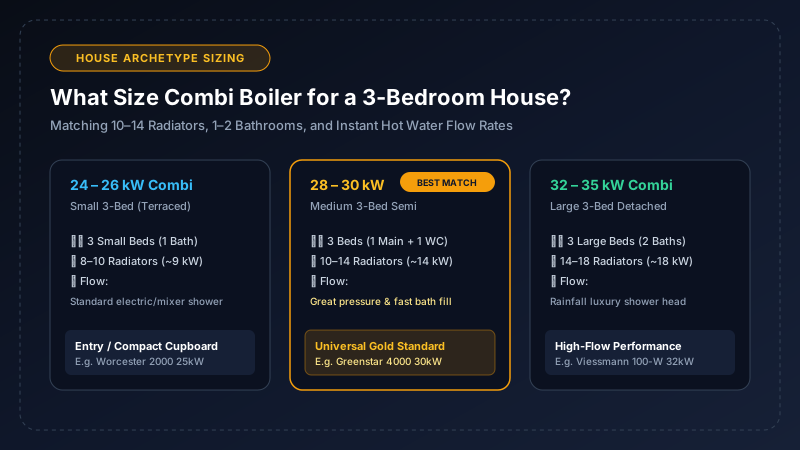
Quick Answer for Featured Snippets:
A 24kW boiler can comfortably run 10 to 14 standard radiators, depending on whether it is a combi boiler or a system boiler:
- 24kW System or Regular Boiler: Can heat up to 14 to 16 average radiators plus a hot water cylinder, because its entire output is dedicated to hydronic heating.
- 24kW Combi Boiler: Typically installed in homes with up to 10 radiators and 1 bathroom. While its heating circuit can technically supply up to 14 radiators, its domestic hot water output is optimized for single-bathroom properties.
- Rule of thumb: Allocate approximately 1.5 kW of boiler power per double-panel (Type 22) radiator, plus a 15% safety margin for pipework losses.
When shopping for a new boiler or planning a home extension, one of the most common questions homeowners ask is: “How many radiators can a 24kW boiler actually run?”
A 24kW boiler is one of the most widely installed boiler sizes across the UK and Europe. However, there is a fundamental difference between what a 24kW combination (combi) boiler can run versus what a 24kW system boiler can run.
1. Combi vs. System Boiler Radiator Capacity
The crucial distinction lies in how the boiler distributes its 24 kilowatts of thermal energy:
The 24kW System Boiler (Dedicated Space Heating)
In a system boiler setup, your hot water is stored in an insulated hot water cylinder. When the heating is running, almost the entire 24kW output can be directed into your central heating radiators:
- Maximum Radiator Capacity: 14 to 16 standard double-panel radiators.
- Home Size: Ideal for 3 to 4-bedroom homes with 1 to 2 bathrooms.
- Cylinder Allowance: 2.5 kW to 3.0 kW is reserved for reheating the cylinder coil.
The 24kW Combi Boiler (Hot Water Driven)
A combi boiler heats water instantaneously as it flows across a plate heat exchanger. The 24kW rating represents its peak domestic hot water (DHW) output (delivering roughly 9.8 litres of hot water per minute at a 35°C temperature rise).
- In space-heating mode, many 24kW combis are internally range-rated by the manufacturer to produce 18 kW to 20 kW for the radiators.
- Maximum Recommended Radiators: Up to 10 radiators.
- Home Size: Ideal for 1 to 2-bedroom flats or small terraced houses with 1 bathroom.
2. Radiator Output Benchmarks: Single vs. Double Panels
Not all radiators consume the same amount of heat. Sizing depends heavily on whether your radiators are single-panel (Type 11) or double-panel double-convector (Type 22):
| Radiator Type | Dimensions (H × W) | Heat Output at ΔT50 | Number a 24kW Boiler Can Run |
|---|---|---|---|
| Type 11 (Single Convector) | 600mm × 800mm | 780 Watts (0.78 kW) | Up to 25 Radiators |
| Type 21 (Double Panel Plus) | 600mm × 1000mm | 1,350 Watts (1.35 kW) | Up to 15 Radiators |
| Type 22 (Double Convector) | 600mm × 1000mm | 1,720 Watts (1.72 kW) | Up to 12 Radiators |
| Type 22 (Large Lounge) | 600mm × 1400mm | 2,410 Watts (2.41 kW) | Up to 8 Radiators |
| Towel Rail (Bathroom) | 1200mm × 500mm | 450 Watts (0.45 kW) | Up to 40 Rails |
3. The 1.5 kW Rule of Thumb Calculation
Heating engineers use a quick baseline formula to check whether a 24kW boiler has adequate margin for a property:
$$Required\ Output\ (kW) = (Number\ of\ Radiators \times 1.5\ kW) \times 1.15$$
- The 1.5 kW multiplier represents the average output of a modern double-panel radiator in typical room sizes.
- The 1.15 factor adds a 15% safety margin for pipework transmission losses.
Worked Example: A Home with 10 Radiators
$$10 \times 1.5\ kW = 15\ kW$$ $$15\ kW \times 1.15 = 17.25\ kW$$ Since 17.25 kW is well below 24 kW, a 24kW system boiler will easily power this home with headroom to spare.
4. What Happens If Your Boiler Is Too Small for Your Radiators?
If you install more radiators than a 24kW boiler can support:
- Long Heat-Up Times: The system will take hours to reach thermostat setpoints on freezing winter mornings.
- Cold Radiators at the End of the Index Run: The radiators furthest from the boiler will remain lukewarm because the circulating water loses all its heat before completing the loop.
- Inability to Condense: The boiler will run continuously at full burner fire without modulating, reducing seasonal efficiency.
5. Calculate Your Exact Home Heating Load
Before committing to a boiler replacement, calculate your exact room-by-room heat loss rather than relying on rough estimates. Use our free engineering calculators:
- Size individual room emitters with our Radiator BTU Calculator.
- Compare combi models on our Combi Boiler Size Calculator.
- Size whole-house heating systems on our System Boiler Size Calculator.
Primary Technical References & Standards
- BS EN 442 (Radiators and Convectors): Testing and rating heat outputs — BSI Standards.
- BS EN 12831-1: Energy performance of buildings — Method for calculation of the design heat load — en-standard.eu.
- CIBSE Domestic Heating Design Guide: Radiator sizing allowances and pipework distribution factors — cibse.org.
- Gas Safe Register Technical Guidance: Safe boiler sizing and commissioning protocols — gassaferegister.co.uk.
Editorial & Calculation Standards
Published by the Boiler Size Calculator Engineering Team. Thermodynamic formulas, radiator derating curves, and hot water flow models adhere strictly to published building services standards, including BS EN 12831-1 and the CIBSE Domestic Heating Design Guide.
Read our Editorial & Corrections Policy or submit a calculation discrepancy to editorial@boilersizecalculator.com.